
Miyya Cody
Resume
About Me
What Happens When You Stop Asking Kids to Sit Still
What Happens When You Stop Asking Kids to Sit Still
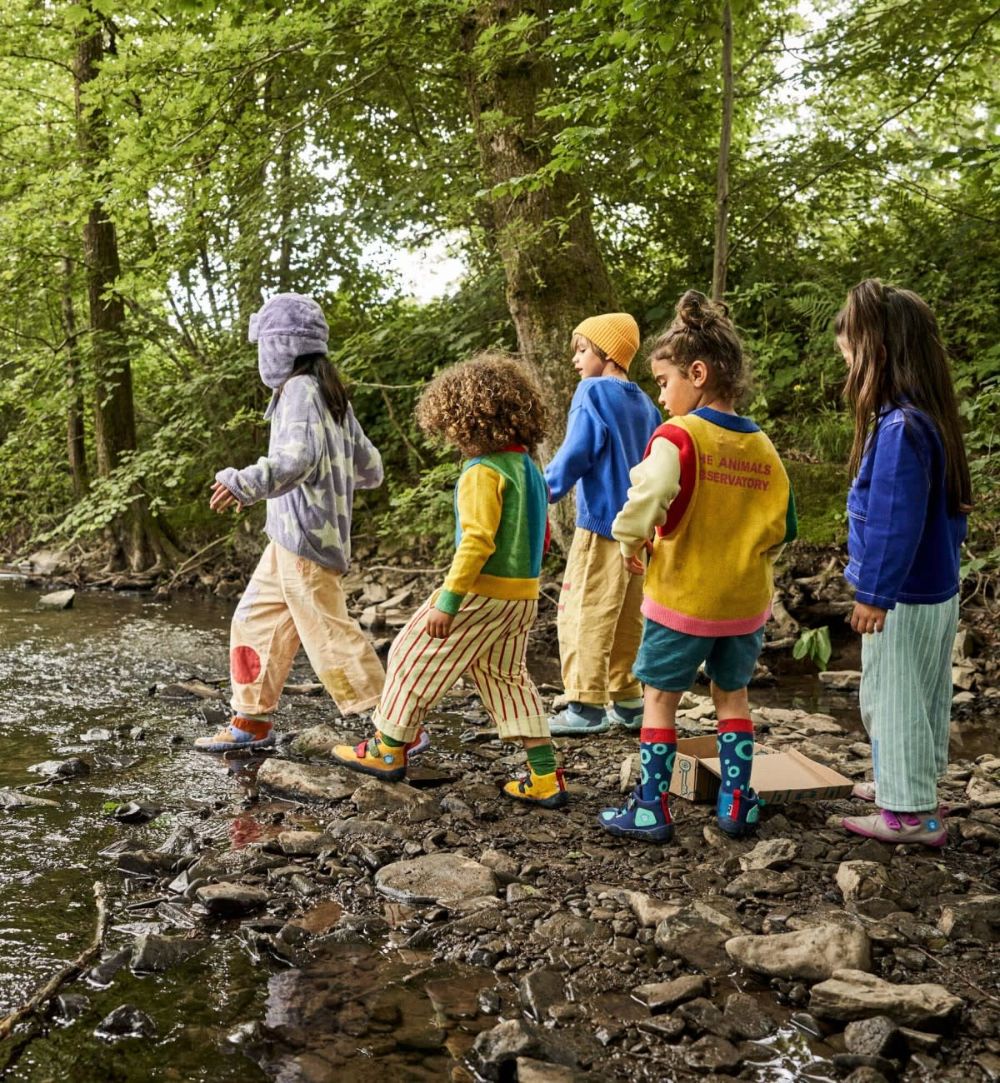
Name/Title | Method | Context |
|---|---|---|
Miyya Cody UX Researcher | Semi-structured interview + in-session experiment, naturalistic observation | Child, age 8, third grade · Multiple sessions across home and school contexts |
A child who voluntarily creates fifth-grade math problems for fun is the same child who can't retain information during a multiplication lesson. That's not a learning problem. That's an environment problem. Here's what I found when I stopped treating that as a contradiction and started treating it as data.
FIELD REPORT FORMAT
This article documents a single extended observation session and draws patterns from it, supported by repeated observations across other sessions. It includes a live in-session experiment — a scenario proposed mid-interview to test whether changing the delivery format changed the response. This is primary qualitative research: exploratory, hypothesis-generating, not controlled. Participant anonymized. Direct quotes reproduced from field notes, not verbatim transcript.
The interview: what he actually said
I asked a third grader whether he likes school. He said yes and immediately qualified it.
Interview Transcript — Session 3
Home context · ~35 min · Semi-structured
Me: Do you like school?
Child: "I do. I just like recess."Not "I like school except for learning." He likes school. He just likes the part where his body is involved. Recess is school to him — it's the version that works.
Me: What happens when your teacher is teaching and you're sitting at your desk?
Child: "I get a little bit attention. But when it comes to too much learning I don't get any attention. I just — I'm bored."Note the threshold model again: not gradual fade, not "I get distracted." He gets some attention, then crosses a line, then gets none. The cliff, not the slope.
Me: Why is it boring?
Child: "Cuz I have nothing to do."Not "it's too hard." Not "I don't understand." Nothing to do. His body has been removed from the learning process entirely, and his brain — which processes through action — has nowhere to put the information. The boredom is structural, not motivational.
He described the physical response: head in his hands, slumping, getting tired. Not defiance. Not distraction. Shutdown. The body has been sidelined and the brain follows.
The live experiment
Mid-interview, I decided to test something directly. I proposed two versions of the same math problem — one at a desk, one embedded in physical activity — and watched what happened to his engagement in real time.
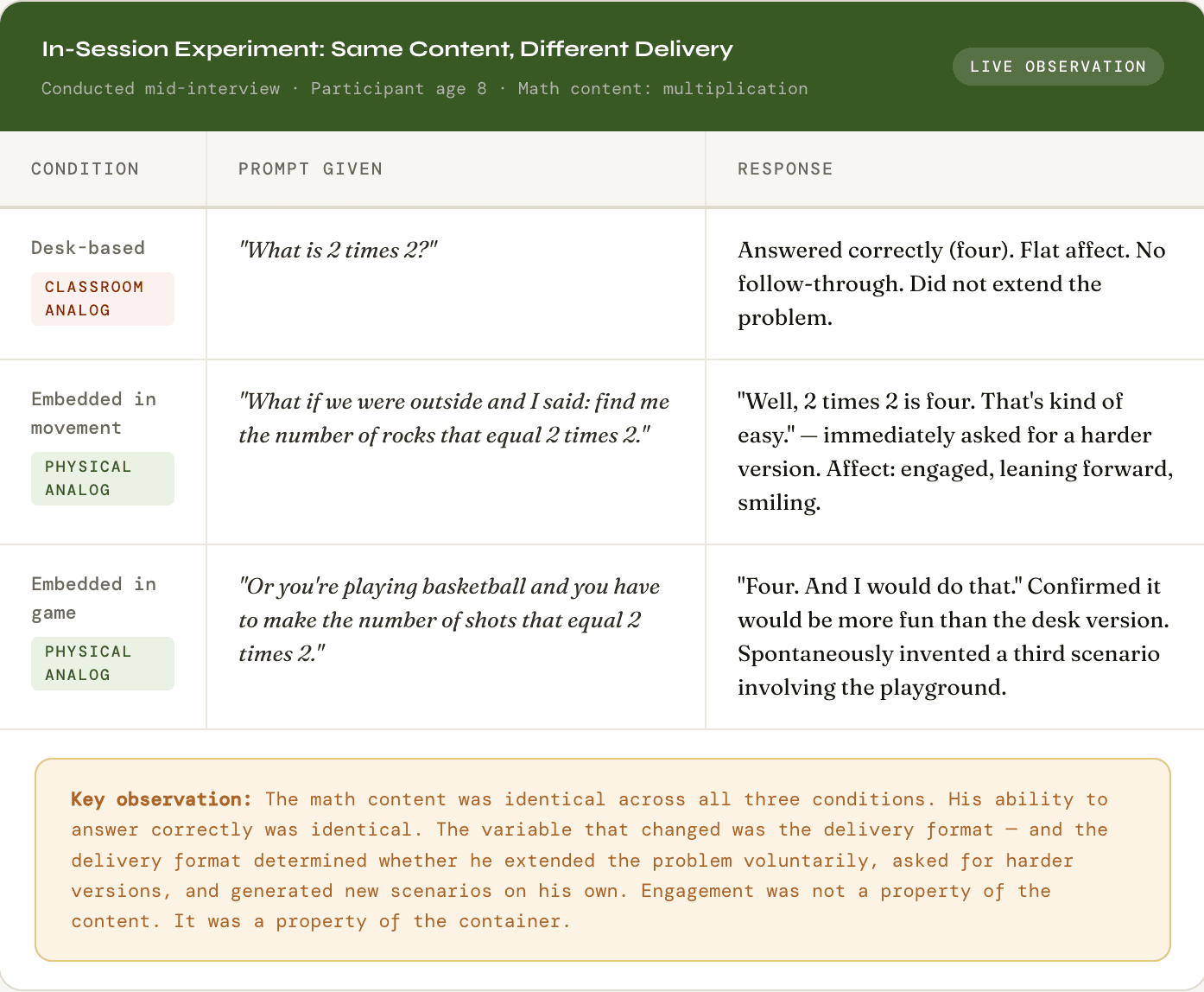
The body is not a distraction from learning. The body is the first processor. When you remove it from the equation, you're asking a child to learn with their primary tool disabled.
Research note, field observation session
Five patterns from repeated observation
This interview crystallized patterns I'd been seeing across multiple sessions and subjects. Each one appears consistently enough to warrant being named as a researchable claim rather than a one-off observation.
Movement is processing architecture, not preference
During physical activity, children are making rapid calculations — angle, force, distance, timing — without conscious effort. The body is doing cognitive work constantly. The classroom asks children to stop doing that and instead watch someone talk about a concept. This doesn't reduce cognitive demand; it increases it, because the child is now fighting their own processing style to stay present. Sitting still is the harder task.
embodied cognitionprocessing loadThe attention cliff is predictable, not pathological
The participant described his attention pattern with precision that surprised me. He gets some focus at the start of instruction. When it extends past a threshold, he doesn't gradually drift — he loses everything. This isn't attention deficit disorder. It's a design flaw in how instruction is paced. The delivery format runs out of runway before the brain has anywhere to put new information. Restructuring the pacing changes the outcome; the child doesn't need to change.
threshold modelpacing designConstruction is the primary encoding mechanism for some children
This participant doesn't play learning games — he builds inside them. He creates questions, selects subjects, calibrates difficulty. When asked why, he couldn't fully articulate it, which is itself a data point: this behavior is instinctive, not strategic. Building the quiz is how he learns the material. The act of construction forces concept decomposition and reassembly — a deeper cognitive operation than any worksheet can produce, because it requires understanding sufficient to generate, not just retrieve.
generative learningproduction effectAbsurdity and humor function as cognitive on-ramps, not noise
The math quiz this participant built was about flatulence. He answered the base problem immediately, then extended it voluntarily: added variables, calculated comparative outcomes, invented follow-up scenarios — all without prompting. That's self-directed mathematical reasoning sustained entirely through intrinsic motivation. Removing the absurd wrapper doesn't make the problem more rigorous. It removes the psychological safety that made voluntarily attempting it feel worth doing.
psychological safetyintrinsic motivationChildren self-regulate difficulty upward when given autonomy
When offered an easy problem (1+1), he dismissed it immediately: "That's a kindergarten question." He self-identified his work as fifth-grade level — two years above his actual placement — and chose it deliberately. He doesn't want easy. He wants challenging, but only when he controls the format and the difficulty. The classroom removes both those levers. The result isn't a child who can't handle difficulty — it's a child who has been given nothing worth trying.
self-determinationautonomy as motivator
What the classroom was actually designed for
The question that stays with me after this research is not why children like this disengage from classrooms. It's obvious why they disengage. The question is what the classroom was optimized for if not their engagement.
CLASSROOM DESIGN PRIORITIES
Compliance and order at scale
Silence as a proxy for learning
Standardized pacing for all learners
Body as liability — stillness required
Instruction → passive reception → test
Mistakes as evidence of deficiency
WHAT THE RESEARCH POINTS TOWARDS
Engagement as the organizing goal
Activity as evidence of processing
Pacing responsive to attention thresholds
Body as primary input — movement as data
Challenge → attempt → consequence → retry
Mistakes as expected events in play
These aren't opposite philosophies — they're different optimization targets. The classroom is optimized for institutional manageability. The environment this research points toward is optimized for how children actually process information. The learner's ceiling is set by which optimization wins.
The prototype: what it looks like built
Prototype Concept In Development
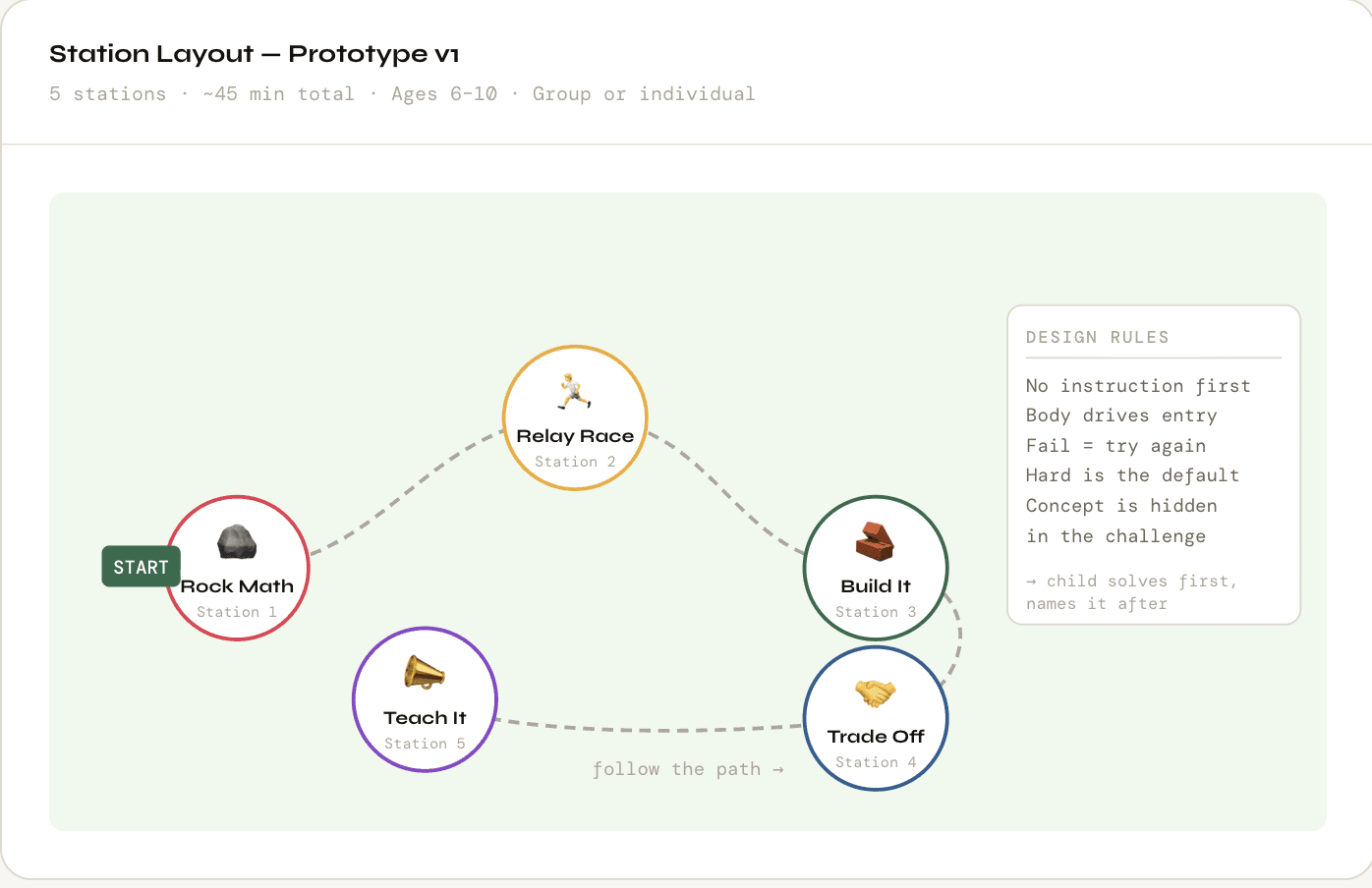
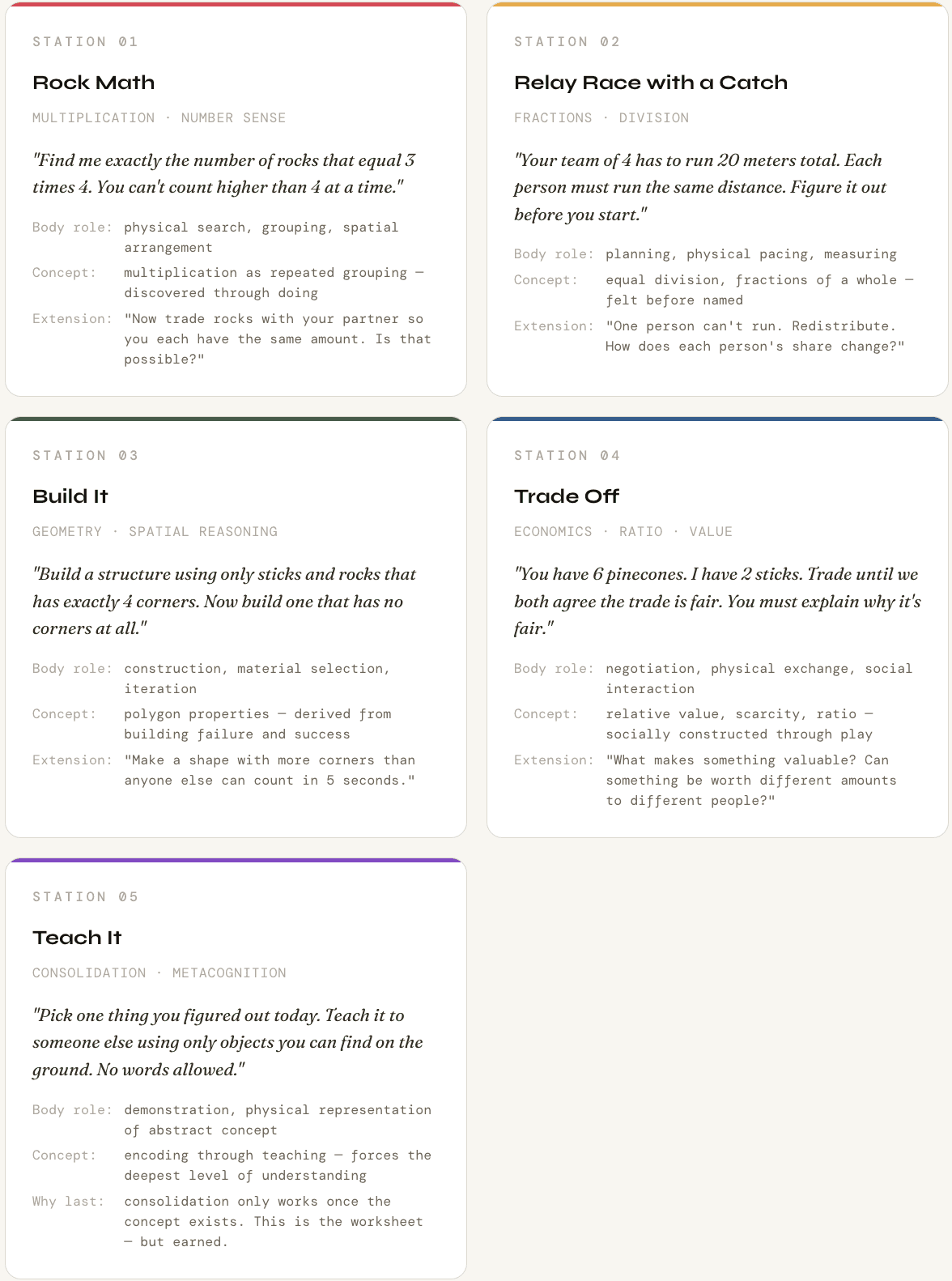
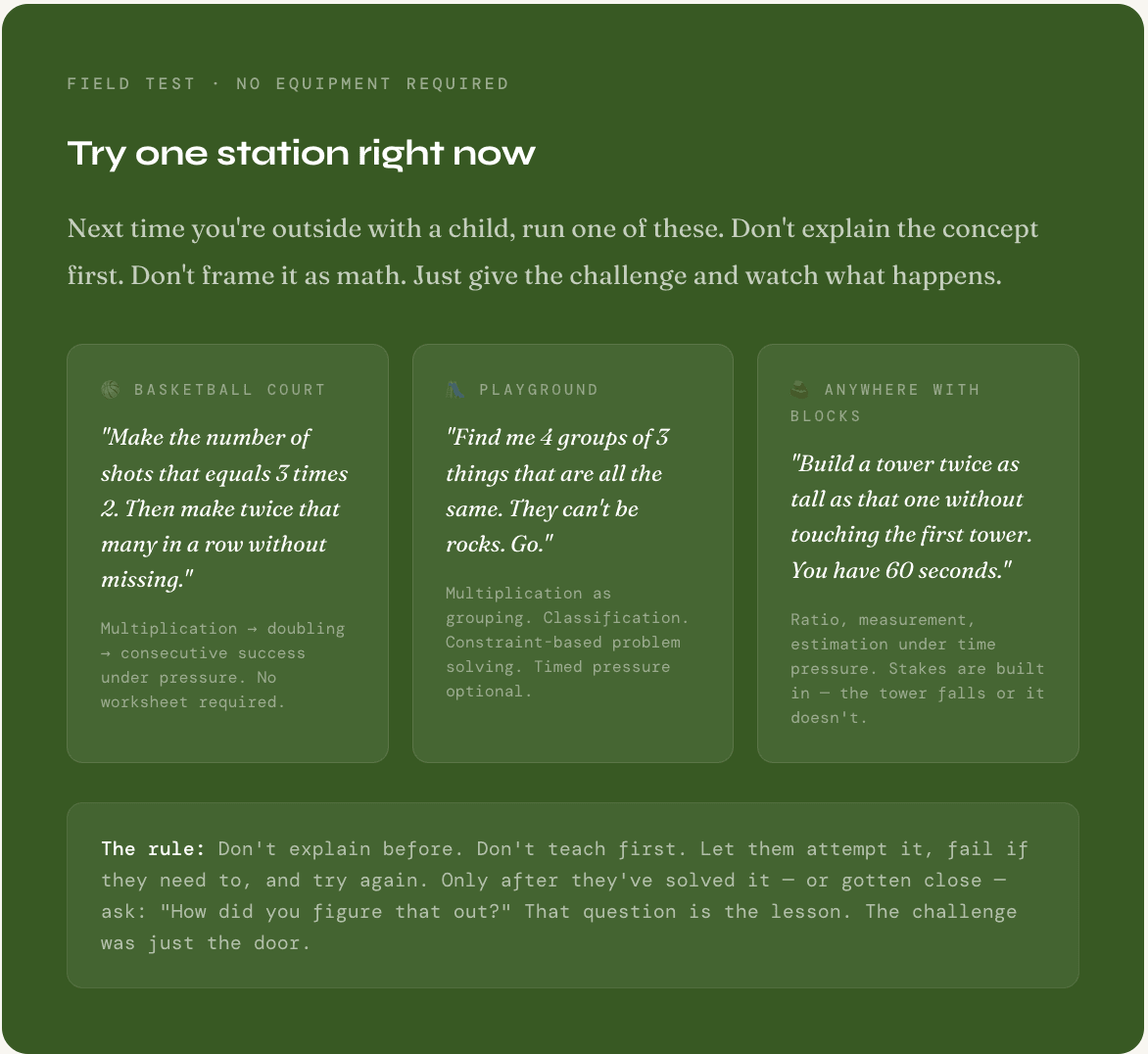
Outdoor Learning Course: Embedded Academic Challenges
An outdoor environment where academic concepts are embedded inside physical challenges — not presented before them. The child encounters the math through the activity, not ahead of it. Each station is designed so that solving the challenge requires the concept, not a prior lecture about it.
On methodology: All observations conducted in naturalistic home and school-adjacent settings. The in-session experiment was not pre-planned — it was improvised mid-interview in response to the participant's description of the classroom vs. recess distinction. This is both a limitation (uncontrolled) and a strength (authentic behavioral signal in context). Participant has been observed across multiple sessions; patterns described here appeared consistently, not once. All names anonymized.
Theoretical grounding: Wilson, M. (2002). Six views of embodied cognition — Psychonomic Bulletin & Review. Vygotsky, L.S. (1978). Mind in Society — on play as the leading activity in child development. Deci, E.L. & Ryan, R.M. (2000). Self-determination theory — on autonomy as a prerequisite for intrinsic motivation. Dewey, J. (1938). Experience and Education — on learning through doing as the primary mode.
Name/Title | Method | Context |
|---|---|---|
Miyya Cody UX Researcher | Semi-structured interview + in-session experiment, naturalistic observation | Child, age 8, third grade · Multiple sessions across home and school contexts |
A child who voluntarily creates fifth-grade math problems for fun is the same child who can't retain information during a multiplication lesson. That's not a learning problem. That's an environment problem. Here's what I found when I stopped treating that as a contradiction and started treating it as data.
FIELD REPORT FORMAT
This article documents a single extended observation session and draws patterns from it, supported by repeated observations across other sessions. It includes a live in-session experiment — a scenario proposed mid-interview to test whether changing the delivery format changed the response. This is primary qualitative research: exploratory, hypothesis-generating, not controlled. Participant anonymized. Direct quotes reproduced from field notes, not verbatim transcript.
The interview: what he actually said
I asked a third grader whether he likes school. He said yes and immediately qualified it.
Interview Transcript — Session 3
Home context · ~35 min · Semi-structured
Me: Do you like school?
Child: "I do. I just like recess."Not "I like school except for learning." He likes school. He just likes the part where his body is involved. Recess is school to him — it's the version that works.
Me: What happens when your teacher is teaching and you're sitting at your desk?
Child: "I get a little bit attention. But when it comes to too much learning I don't get any attention. I just — I'm bored."Note the threshold model again: not gradual fade, not "I get distracted." He gets some attention, then crosses a line, then gets none. The cliff, not the slope.
Me: Why is it boring?
Child: "Cuz I have nothing to do."Not "it's too hard." Not "I don't understand." Nothing to do. His body has been removed from the learning process entirely, and his brain — which processes through action — has nowhere to put the information. The boredom is structural, not motivational.
He described the physical response: head in his hands, slumping, getting tired. Not defiance. Not distraction. Shutdown. The body has been sidelined and the brain follows.
The live experiment
Mid-interview, I decided to test something directly. I proposed two versions of the same math problem — one at a desk, one embedded in physical activity — and watched what happened to his engagement in real time.
The body is not a distraction from learning. The body is the first processor. When you remove it from the equation, you're asking a child to learn with their primary tool disabled.
Research note, field observation session
Five patterns from repeated observation
This interview crystallized patterns I'd been seeing across multiple sessions and subjects. Each one appears consistently enough to warrant being named as a researchable claim rather than a one-off observation.
Movement is processing architecture, not preference
During physical activity, children are making rapid calculations — angle, force, distance, timing — without conscious effort. The body is doing cognitive work constantly. The classroom asks children to stop doing that and instead watch someone talk about a concept. This doesn't reduce cognitive demand; it increases it, because the child is now fighting their own processing style to stay present. Sitting still is the harder task.
embodied cognitionprocessing loadThe attention cliff is predictable, not pathological
The participant described his attention pattern with precision that surprised me. He gets some focus at the start of instruction. When it extends past a threshold, he doesn't gradually drift — he loses everything. This isn't attention deficit disorder. It's a design flaw in how instruction is paced. The delivery format runs out of runway before the brain has anywhere to put new information. Restructuring the pacing changes the outcome; the child doesn't need to change.
threshold modelpacing designConstruction is the primary encoding mechanism for some children
This participant doesn't play learning games — he builds inside them. He creates questions, selects subjects, calibrates difficulty. When asked why, he couldn't fully articulate it, which is itself a data point: this behavior is instinctive, not strategic. Building the quiz is how he learns the material. The act of construction forces concept decomposition and reassembly — a deeper cognitive operation than any worksheet can produce, because it requires understanding sufficient to generate, not just retrieve.
generative learningproduction effectAbsurdity and humor function as cognitive on-ramps, not noise
The math quiz this participant built was about flatulence. He answered the base problem immediately, then extended it voluntarily: added variables, calculated comparative outcomes, invented follow-up scenarios — all without prompting. That's self-directed mathematical reasoning sustained entirely through intrinsic motivation. Removing the absurd wrapper doesn't make the problem more rigorous. It removes the psychological safety that made voluntarily attempting it feel worth doing.
psychological safetyintrinsic motivationChildren self-regulate difficulty upward when given autonomy
When offered an easy problem (1+1), he dismissed it immediately: "That's a kindergarten question." He self-identified his work as fifth-grade level — two years above his actual placement — and chose it deliberately. He doesn't want easy. He wants challenging, but only when he controls the format and the difficulty. The classroom removes both those levers. The result isn't a child who can't handle difficulty — it's a child who has been given nothing worth trying.
self-determinationautonomy as motivator
What the classroom was actually designed for
The question that stays with me after this research is not why children like this disengage from classrooms. It's obvious why they disengage. The question is what the classroom was optimized for if not their engagement.
CLASSROOM DESIGN PRIORITIES
Compliance and order at scale
Silence as a proxy for learning
Standardized pacing for all learners
Body as liability — stillness required
Instruction → passive reception → test
Mistakes as evidence of deficiency
WHAT THE RESEARCH POINTS TOWARDS
Engagement as the organizing goal
Activity as evidence of processing
Pacing responsive to attention thresholds
Body as primary input — movement as data
Challenge → attempt → consequence → retry
Mistakes as expected events in play
These aren't opposite philosophies — they're different optimization targets. The classroom is optimized for institutional manageability. The environment this research points toward is optimized for how children actually process information. The learner's ceiling is set by which optimization wins.
The prototype: what it looks like built
Prototype Concept In Development
Outdoor Learning Course: Embedded Academic Challenges
An outdoor environment where academic concepts are embedded inside physical challenges — not presented before them. The child encounters the math through the activity, not ahead of it. Each station is designed so that solving the challenge requires the concept, not a prior lecture about it.
On methodology: All observations conducted in naturalistic home and school-adjacent settings. The in-session experiment was not pre-planned — it was improvised mid-interview in response to the participant's description of the classroom vs. recess distinction. This is both a limitation (uncontrolled) and a strength (authentic behavioral signal in context). Participant has been observed across multiple sessions; patterns described here appeared consistently, not once. All names anonymized.
Theoretical grounding: Wilson, M. (2002). Six views of embodied cognition — Psychonomic Bulletin & Review. Vygotsky, L.S. (1978). Mind in Society — on play as the leading activity in child development. Deci, E.L. & Ryan, R.M. (2000). Self-determination theory — on autonomy as a prerequisite for intrinsic motivation. Dewey, J. (1938). Experience and Education — on learning through doing as the primary mode.