
Miyya Cody
Resume
About Me
Gross, Weird, Absurd, and Educationally Sound
Gross, Weird, Absurd, and Educationally Sound

Name/Title | Method | Context |
|---|---|---|
Miyya Cody UX Researcher · Unschooled | Naturalistic observation, behavioral analysis, media analysis | Children ages 5–10, home and informal learning environments |
I didn't set out to study humor. I was studying engagement. Then I noticed that every child who was deeply focused was either laughing, being weird, or working with something deliberately absurd, and every disengaged child was sitting in a room that had been stripped of all three.
Framing Note
This article blends observational research with analytical argument. Primary data comes from behavioral observation of children ages 5–10 across home and informal learning environments, plus analysis of voluntarily-chosen media as a proxy for autonomous engagement. The central claim — that absurdity functions as a structural pedagogical mechanism rather than incidental noise — is a hypothesis generated from pattern analysis, not a controlled experimental finding. References to cognitive science and educational theory are included to situate the observation within existing research, not to claim derivation from it.
How humor became a research variable
Humor kept appearing in my data and I kept coding it out. In qualitative research, you make choices about what counts as signal and what counts as context. For a long time, I treated children's laughter and silliness as context — the ambient noise of working with kids, not a variable worth tracking in its own right.
The pattern that changed my mind was this: I could not find a single instance of deep, sustained, voluntary engagement that didn't involve humor, absurdity, or play. Not one. I looked for a counterexample and kept failing to find it. That's not proof of anything, but it is a methodological prompt — a signal that the thing I was discarding might be the thing I should be studying.
So I started paying attention to the jokes.
The mechanism: why absurdity works on children's brains
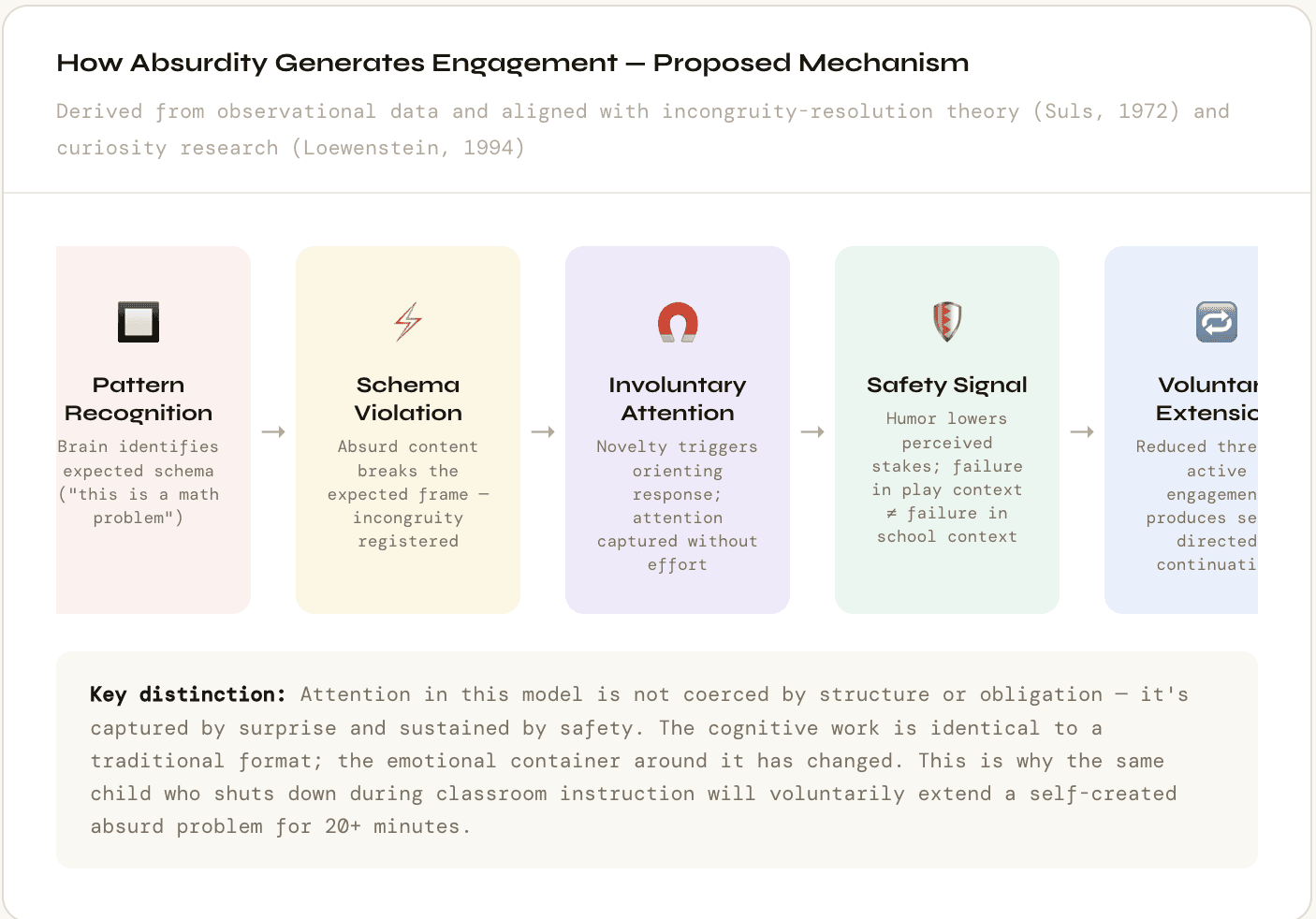
Children's brains are, in the most literal sense, novelty-detection machines. The developing prefrontal cortex is actively building mental models of how the world works — which means anything that violates those models gets flagged, processed, and remembered. This is an evolutionary feature. Noticing the unexpected is how young brains stay calibrated.
Absurdity is deliberate pattern-breaking. A word problem about two trains leaving a station fits every expectation a child has built about what school feels like. It activates a frame that, for many children, is already associated with boredom and the risk of being publicly wrong. The brain recognizes the template and responds with the same low-engagement posture it's learned to bring to that template.
A word problem about two dinosaurs racing to a taco stand breaks the pattern immediately. The brain flags the incongruity — wait, that's not how math problems work — and leans in. Attention is captured not through instruction or discipline but through surprise. And surprise, unlike obligation, is intrinsically motivating.
One fart quiz, dissected
A child in third grade showed me a math quiz he built inside Blooket — a learning game platform — entirely without being asked. The question he wrote:
Field Observation · Voluntary Learning Activity • Age 8"If I farted two times, and Naomi farted two times, and Michael farted two times, how many farts is that?"
He answered immediately (six), then extended the problem unprompted: "It stinks six times more than one person farting." He then brought in additional variables — comparative intensity, cumulative effects — and kept calculating. He laughed through the entire thing. He was doing fifth-grade-level voluntary math. This is the same child who puts his head down during classroom instruction in the same subject.
My instinct was to look past the joke and focus on the math. But the longer I sat with this observation, the more clearly I saw that the joke was the finding. The humor wasn't incidental to the learning. It was the reason the learning happened at all.
Breaking Down What Actually Happened
He chose to build, not consume
Most children use Blooket to play existing quizzes. This child creates them. Production requires encoding — to build a math problem, you have to understand the underlying concept well enough to construct it. He was learning by authoring, not by receiving. The absurdity was the motivational frame that made authoring feel worth doing.
Creation as encodingHe chose the difficulty
When I offered a simpler problem, he rejected it: "That's a kindergarten question." He self-identified as working at a fifth-grade level — two years above his actual placement. The absurdity and the rigor coexist. He's not reaching for silliness because he can't handle real content. He's reaching for silliness while handling content that exceeds grade expectations.
Upward difficulty regulationHe extended the problem without prompting
After answering "six," he didn't stop. He introduced new variables — comparative smell intensity, cumulative effects — and kept calculating. No teacher asked. No assignment required it. The joke created a context where thinking felt like playing, and so he kept playing. This is self-directed mathematical reasoning sustained entirely by intrinsic motivation. The absurd wrapper made the math feel consequence-free, which made him willing to push further than any structured task would have.
Voluntary extension
He's not building fart quizzes because he can't handle real math. He's building fart quizzes because the joke makes it safe to try hard.
Research note, voluntary learning observation
What children's media already knows
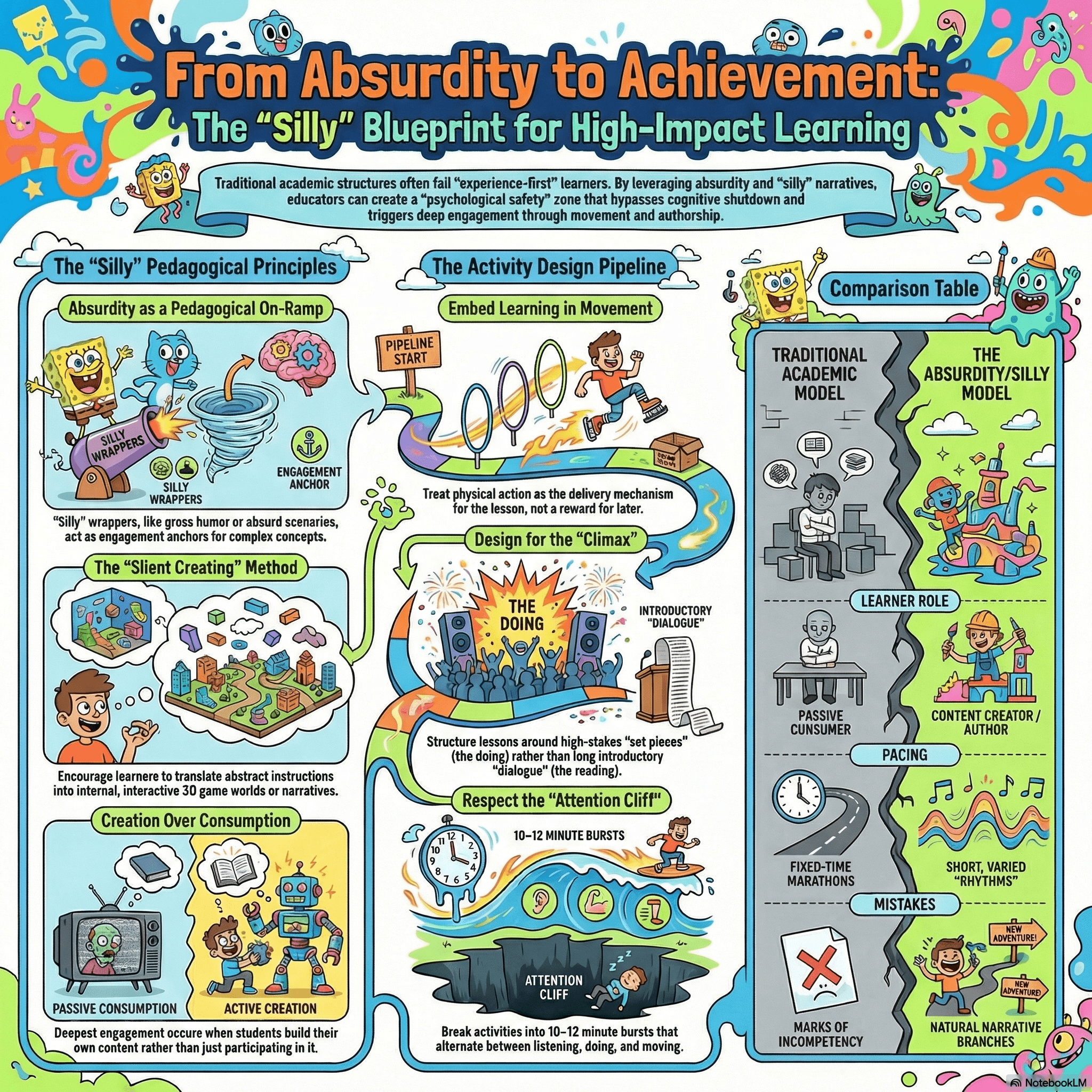
I started treating children's voluntarily-chosen media as a data source — not for what it teaches explicitly, but for what engagement patterns it reveals. The content children are most obsessed with is almost universally absurd. And when you look past the surface weirdness, every one of these shows is doing sophisticated conceptual work.
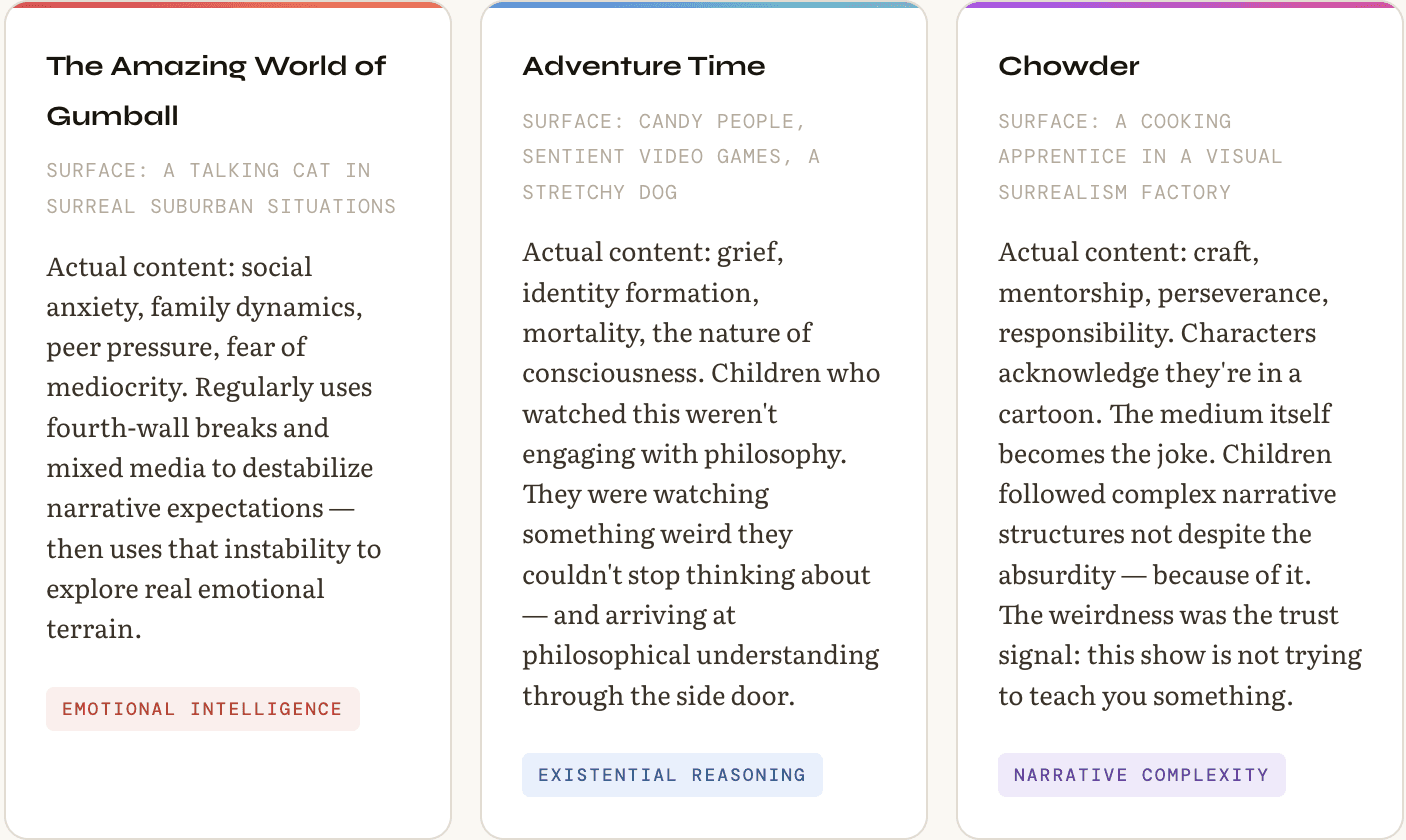
These shows aren't successful despite being weird. They're successful because they're weird. The absurdity is the delivery vehicle for ideas that would disengage children in a direct format. The creators understood something educational designers consistently miss: you don't earn a child's sustained attention by being clear and serious. You earn it by being surprising enough that they need to find out what happens next.
Structural absurdity vs. decorative absurdity
The critical distinction — the one that separates pedagogically useful absurdity from theater — is whether the silliness is structural or decorative.
Decorative absurdity means putting a cartoon character on a worksheet. The frame is unchanged. The child's brain still reads the experience as school, with all the associations that carries. The absurdity is surface-level; it doesn't change what the learner is being asked to do or how safe it feels to attempt it.
Structural absurdity means the weirdness is embedded in the task itself. The problem is funny. The scenario is unpredictable. The challenge requires the child to engage with the absurdity to complete the cognitive work.
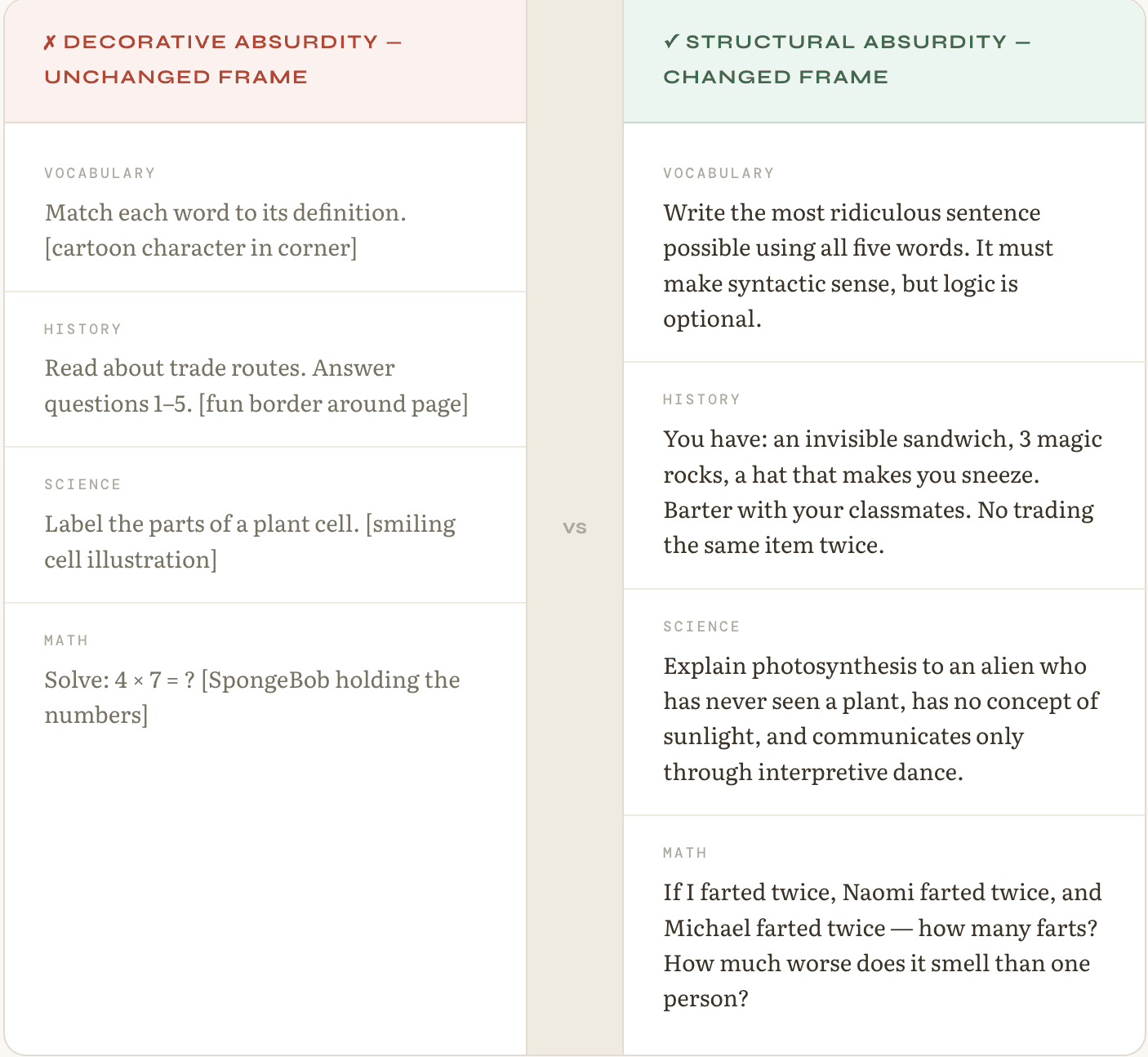
In every structural example, the learning objective is identical to the traditional version. The child still has to understand vocabulary meaning and syntax. They still have to understand economic principles of scarcity and value. They still have to understand photosynthesis deeply enough to translate it into a radically different context — which is a higher-order cognitive demand than labeling a diagram. The absurdity isn't lowering the bar. It's changing the door. The child arrives at the same understanding through an entrance that doesn't trigger the performance anxiety of the original.
The psychological safety layer
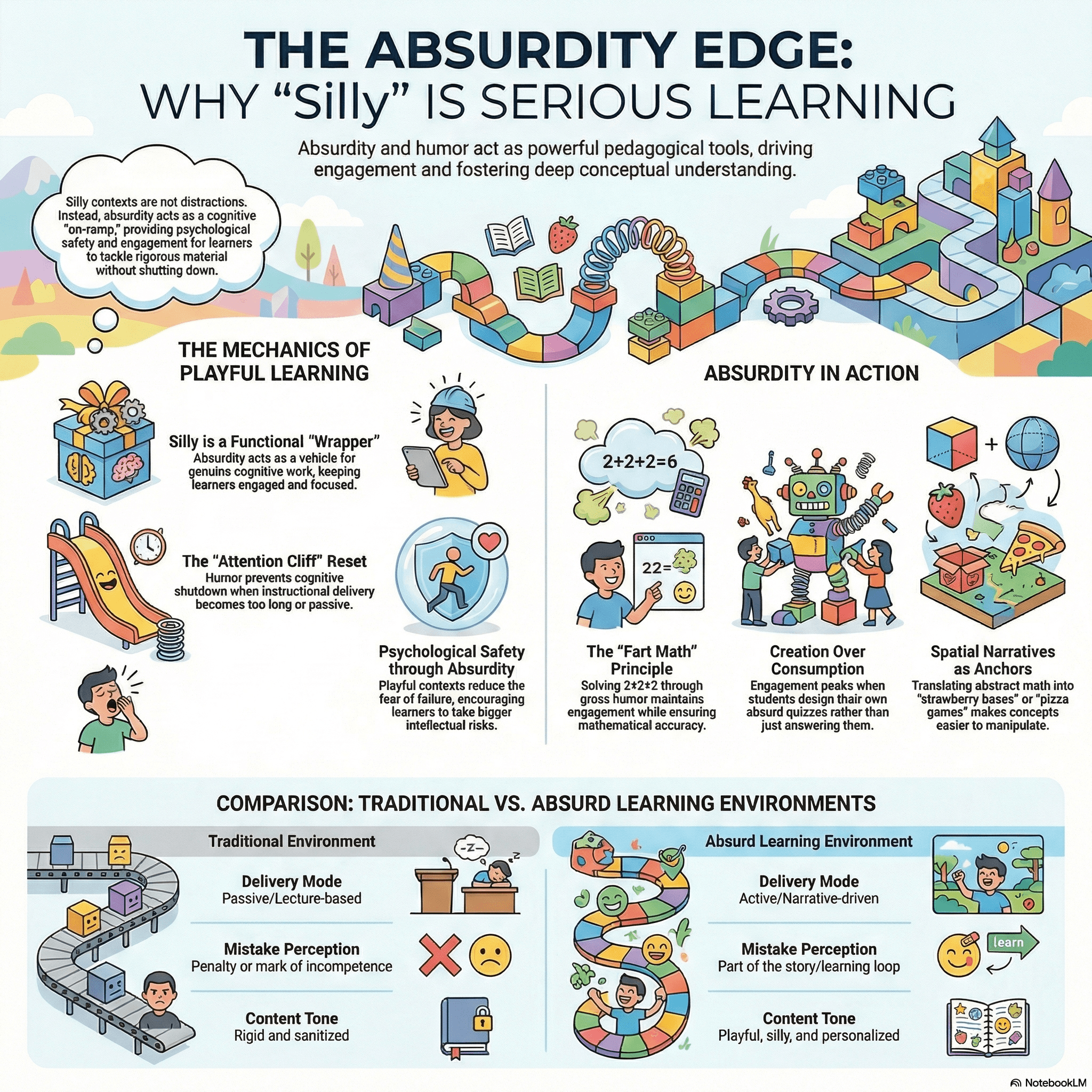
There's a mechanism beneath the novelty effect that I think matters more: absurdity creates psychological safety.
One of the most consistent patterns across my observations is that children disengage from learning not because the material is too hard, but because the consequences of being wrong feel too heavy. A child who fears getting a math problem wrong will avoid the problem — choose lower difficulty, rush without thinking, or shut down. The fear isn't about the math. It's about the social cost of public failure in an environment that treats mistakes as evidence of deficiency.
Silliness dissolves that fear. A child who is afraid of getting a math problem wrong is not afraid of getting a joke wrong. The stakes feel categorically different. When you wrap a multiplication problem inside a joke about competitive flatulence, the child isn't performing anymore — they're playing. And play is the one context where mistakes are expected, even funny. You mess up, you laugh, you try again. The cognitive work is identical. The emotional container around it has completely changed.
This is why the child in my observation builds quizzes about farts instead of trains. It isn't immaturity. It's self-protective engineering. He's instinctively constructing an emotional environment where it's safe to think hard, get things wrong, and keep going — because the whole premise is funny, so nothing is catastrophic. He designed his own psychological safety net at eight years old, without anyone teaching him to.
What educational design gets wrong
The instinct in most educational design is to make content clean, structured, and serious. This isn't arbitrary — it comes from a genuine belief that learning is important and should be treated with corresponding gravity. But that belief produces environments optimized for the comfort of adults and the legibility of institutions, not the engagement of children.
When we strip humor from learning materials, we don't make them more rigorous. We make them more sterile. And sterility is the fastest path to disengagement for a brain wired to seek novelty, surprise, and pattern-violation. The shows children love understand this. The games children play understand this. The jokes children tell each other on playgrounds understand this. The one institution that consistently fails to account for it is the one designed specifically for learning.
The argument here isn't that every lesson should be a comedy routine. It's that the emotional tone of a learning environment is a design variable — and one that most educational environments have set to a value that actively works against the population it's supposed to serve. Absurdity, humor, and playful weirdness aren't distractions to manage. They're mechanisms to deploy.
Applied Research · Try This at Home
Turn the show they watch on repeat into a literacy engine
You already have the most effective engagement tool in your house. It's whatever your kid watches obsessively. Here's how to use it as a research-grade learning environment — without them knowing that's what's happening.
Watch an episode together — no agenda
Don't announce what comes next. Just watch. Let them lead the commentary, notice what makes them laugh, and observe which moments make them lean in. You're gathering baseline engagement data.
→ establishes their intrinsic motivation anchor
Ask them to write a new episode — not a summary
A summary is retrieval. A new episode is generation. To write new dialogue that sounds right, they have to model character voice and understand motivation. To construct a plot, they have to sequence cause and effect. To give the episode a satisfying ending, they have to understand narrative structure. That's every skill a language arts curriculum requires — inside a world they already care about.
→ writing as encoding, not performance
Let it be gross. Encourage weird.
A Chowder episode where every recipe causes a disgusting side effect requires descriptive language, sequencing, and creative problem-solving. A SpongeBob episode where Bikini Bottom runs out of toilet paper is satire — they just don't know it yet. The absurdity is not the problem. It's the mechanism. Resist the instinct to redirect them toward something "educational." They're already there.
→ structural absurdity at work
Replace comprehension questions with real questions
Skip "what was the theme?" It's a school question and their brain knows it. Ask something they'll actually want to answer. The cognitive demand is identical — or higher. The emotional frame is completely different.
→ argumentation inside a safe context
Question design — same cognitive demand, different frame
SKIP THIS | ASK THIS INSTEAD |
|---|---|
"What was the theme of this episode? What lesson did the character learn?" | "Do you think Gumball was right to keep the secret? What would have happened if he told the truth at the beginning? Would that have been better or worse?" |
A child who will talk for twenty minutes about why a character's plan backfired but won't write a paragraph about a book they didn't choose isn't showing a lack of ability. They're showing you where their motivation lives. The research case for meeting them there is stronger than the case for expecting them to meet you where you are.
On methodology: Behavioral observations were conducted in naturalistic settings. No experimental controls were applied. Children's media analysis is interpretive, not quantitative. Claims about cognitive mechanisms are grounded in cited theory but are not derived from controlled experiments in this research. All findings should be read as hypotheses for further testing.
Relevant frameworks: Suls, J.M. (1972). A two-stage model for the appreciation of jokes and cartoons. Loewenstein, G. (1994). The psychology of curiosity. Csikszentmihalyi, M. (1990). Flow: The psychology of optimal experience. Vygotsky, L.S. (1978). Mind in society: The development of higher psychological processes (on play as leading activity in child development).
Name/Title | Method | Context |
|---|---|---|
Miyya Cody UX Researcher · Unschooled | Naturalistic observation, behavioral analysis, media analysis | Children ages 5–10, home and informal learning environments |
I didn't set out to study humor. I was studying engagement. Then I noticed that every child who was deeply focused was either laughing, being weird, or working with something deliberately absurd, and every disengaged child was sitting in a room that had been stripped of all three.
Framing Note
This article blends observational research with analytical argument. Primary data comes from behavioral observation of children ages 5–10 across home and informal learning environments, plus analysis of voluntarily-chosen media as a proxy for autonomous engagement. The central claim — that absurdity functions as a structural pedagogical mechanism rather than incidental noise — is a hypothesis generated from pattern analysis, not a controlled experimental finding. References to cognitive science and educational theory are included to situate the observation within existing research, not to claim derivation from it.
How humor became a research variable
Humor kept appearing in my data and I kept coding it out. In qualitative research, you make choices about what counts as signal and what counts as context. For a long time, I treated children's laughter and silliness as context — the ambient noise of working with kids, not a variable worth tracking in its own right.
The pattern that changed my mind was this: I could not find a single instance of deep, sustained, voluntary engagement that didn't involve humor, absurdity, or play. Not one. I looked for a counterexample and kept failing to find it. That's not proof of anything, but it is a methodological prompt — a signal that the thing I was discarding might be the thing I should be studying.
So I started paying attention to the jokes.
The mechanism: why absurdity works on children's brains
Children's brains are, in the most literal sense, novelty-detection machines. The developing prefrontal cortex is actively building mental models of how the world works — which means anything that violates those models gets flagged, processed, and remembered. This is an evolutionary feature. Noticing the unexpected is how young brains stay calibrated.
Absurdity is deliberate pattern-breaking. A word problem about two trains leaving a station fits every expectation a child has built about what school feels like. It activates a frame that, for many children, is already associated with boredom and the risk of being publicly wrong. The brain recognizes the template and responds with the same low-engagement posture it's learned to bring to that template.
A word problem about two dinosaurs racing to a taco stand breaks the pattern immediately. The brain flags the incongruity — wait, that's not how math problems work — and leans in. Attention is captured not through instruction or discipline but through surprise. And surprise, unlike obligation, is intrinsically motivating.
One fart quiz, dissected
A child in third grade showed me a math quiz he built inside Blooket — a learning game platform — entirely without being asked. The question he wrote:
Field Observation · Voluntary Learning Activity • Age 8"If I farted two times, and Naomi farted two times, and Michael farted two times, how many farts is that?"
He answered immediately (six), then extended the problem unprompted: "It stinks six times more than one person farting." He then brought in additional variables — comparative intensity, cumulative effects — and kept calculating. He laughed through the entire thing. He was doing fifth-grade-level voluntary math. This is the same child who puts his head down during classroom instruction in the same subject.
My instinct was to look past the joke and focus on the math. But the longer I sat with this observation, the more clearly I saw that the joke was the finding. The humor wasn't incidental to the learning. It was the reason the learning happened at all.
Breaking Down What Actually Happened
He chose to build, not consume
Most children use Blooket to play existing quizzes. This child creates them. Production requires encoding — to build a math problem, you have to understand the underlying concept well enough to construct it. He was learning by authoring, not by receiving. The absurdity was the motivational frame that made authoring feel worth doing.
Creation as encodingHe chose the difficulty
When I offered a simpler problem, he rejected it: "That's a kindergarten question." He self-identified as working at a fifth-grade level — two years above his actual placement. The absurdity and the rigor coexist. He's not reaching for silliness because he can't handle real content. He's reaching for silliness while handling content that exceeds grade expectations.
Upward difficulty regulationHe extended the problem without prompting
After answering "six," he didn't stop. He introduced new variables — comparative smell intensity, cumulative effects — and kept calculating. No teacher asked. No assignment required it. The joke created a context where thinking felt like playing, and so he kept playing. This is self-directed mathematical reasoning sustained entirely by intrinsic motivation. The absurd wrapper made the math feel consequence-free, which made him willing to push further than any structured task would have.
Voluntary extension
He's not building fart quizzes because he can't handle real math. He's building fart quizzes because the joke makes it safe to try hard.
Research note, voluntary learning observation
What children's media already knows
I started treating children's voluntarily-chosen media as a data source — not for what it teaches explicitly, but for what engagement patterns it reveals. The content children are most obsessed with is almost universally absurd. And when you look past the surface weirdness, every one of these shows is doing sophisticated conceptual work.
These shows aren't successful despite being weird. They're successful because they're weird. The absurdity is the delivery vehicle for ideas that would disengage children in a direct format. The creators understood something educational designers consistently miss: you don't earn a child's sustained attention by being clear and serious. You earn it by being surprising enough that they need to find out what happens next.
Structural absurdity vs. decorative absurdity
The critical distinction — the one that separates pedagogically useful absurdity from theater — is whether the silliness is structural or decorative.
Decorative absurdity means putting a cartoon character on a worksheet. The frame is unchanged. The child's brain still reads the experience as school, with all the associations that carries. The absurdity is surface-level; it doesn't change what the learner is being asked to do or how safe it feels to attempt it.
Structural absurdity means the weirdness is embedded in the task itself. The problem is funny. The scenario is unpredictable. The challenge requires the child to engage with the absurdity to complete the cognitive work.
In every structural example, the learning objective is identical to the traditional version. The child still has to understand vocabulary meaning and syntax. They still have to understand economic principles of scarcity and value. They still have to understand photosynthesis deeply enough to translate it into a radically different context — which is a higher-order cognitive demand than labeling a diagram. The absurdity isn't lowering the bar. It's changing the door. The child arrives at the same understanding through an entrance that doesn't trigger the performance anxiety of the original.
The psychological safety layer
There's a mechanism beneath the novelty effect that I think matters more: absurdity creates psychological safety.
One of the most consistent patterns across my observations is that children disengage from learning not because the material is too hard, but because the consequences of being wrong feel too heavy. A child who fears getting a math problem wrong will avoid the problem — choose lower difficulty, rush without thinking, or shut down. The fear isn't about the math. It's about the social cost of public failure in an environment that treats mistakes as evidence of deficiency.
Silliness dissolves that fear. A child who is afraid of getting a math problem wrong is not afraid of getting a joke wrong. The stakes feel categorically different. When you wrap a multiplication problem inside a joke about competitive flatulence, the child isn't performing anymore — they're playing. And play is the one context where mistakes are expected, even funny. You mess up, you laugh, you try again. The cognitive work is identical. The emotional container around it has completely changed.
This is why the child in my observation builds quizzes about farts instead of trains. It isn't immaturity. It's self-protective engineering. He's instinctively constructing an emotional environment where it's safe to think hard, get things wrong, and keep going — because the whole premise is funny, so nothing is catastrophic. He designed his own psychological safety net at eight years old, without anyone teaching him to.
What educational design gets wrong
The instinct in most educational design is to make content clean, structured, and serious. This isn't arbitrary — it comes from a genuine belief that learning is important and should be treated with corresponding gravity. But that belief produces environments optimized for the comfort of adults and the legibility of institutions, not the engagement of children.
When we strip humor from learning materials, we don't make them more rigorous. We make them more sterile. And sterility is the fastest path to disengagement for a brain wired to seek novelty, surprise, and pattern-violation. The shows children love understand this. The games children play understand this. The jokes children tell each other on playgrounds understand this. The one institution that consistently fails to account for it is the one designed specifically for learning.
The argument here isn't that every lesson should be a comedy routine. It's that the emotional tone of a learning environment is a design variable — and one that most educational environments have set to a value that actively works against the population it's supposed to serve. Absurdity, humor, and playful weirdness aren't distractions to manage. They're mechanisms to deploy.
Applied Research · Try This at Home
Turn the show they watch on repeat into a literacy engine
You already have the most effective engagement tool in your house. It's whatever your kid watches obsessively. Here's how to use it as a research-grade learning environment — without them knowing that's what's happening.
Watch an episode together — no agenda
Don't announce what comes next. Just watch. Let them lead the commentary, notice what makes them laugh, and observe which moments make them lean in. You're gathering baseline engagement data.
→ establishes their intrinsic motivation anchor
Ask them to write a new episode — not a summary
A summary is retrieval. A new episode is generation. To write new dialogue that sounds right, they have to model character voice and understand motivation. To construct a plot, they have to sequence cause and effect. To give the episode a satisfying ending, they have to understand narrative structure. That's every skill a language arts curriculum requires — inside a world they already care about.
→ writing as encoding, not performance
Let it be gross. Encourage weird.
A Chowder episode where every recipe causes a disgusting side effect requires descriptive language, sequencing, and creative problem-solving. A SpongeBob episode where Bikini Bottom runs out of toilet paper is satire — they just don't know it yet. The absurdity is not the problem. It's the mechanism. Resist the instinct to redirect them toward something "educational." They're already there.
→ structural absurdity at work
Replace comprehension questions with real questions
Skip "what was the theme?" It's a school question and their brain knows it. Ask something they'll actually want to answer. The cognitive demand is identical — or higher. The emotional frame is completely different.
→ argumentation inside a safe context
Question design — same cognitive demand, different frame
SKIP THIS | ASK THIS INSTEAD |
|---|---|
"What was the theme of this episode? What lesson did the character learn?" | "Do you think Gumball was right to keep the secret? What would have happened if he told the truth at the beginning? Would that have been better or worse?" |
A child who will talk for twenty minutes about why a character's plan backfired but won't write a paragraph about a book they didn't choose isn't showing a lack of ability. They're showing you where their motivation lives. The research case for meeting them there is stronger than the case for expecting them to meet you where you are.
On methodology: Behavioral observations were conducted in naturalistic settings. No experimental controls were applied. Children's media analysis is interpretive, not quantitative. Claims about cognitive mechanisms are grounded in cited theory but are not derived from controlled experiments in this research. All findings should be read as hypotheses for further testing.
Relevant frameworks: Suls, J.M. (1972). A two-stage model for the appreciation of jokes and cartoons. Loewenstein, G. (1994). The psychology of curiosity. Csikszentmihalyi, M. (1990). Flow: The psychology of optimal experience. Vygotsky, L.S. (1978). Mind in society: The development of higher psychological processes (on play as leading activity in child development).