
Miyya Cody
Resume
About Me
The Attention Problem is a Design Problem
The Attention Problem is a Design Problem

Name/Title | Method | Participants |
|---|---|---|
Miyya Cody Full Stack Product Designer | Semi-structured interviews Behavioral Observations | n=2; Ages 9 - 26 Independent Case Analysis |
Two participants. Twenty years apart in age. Completely different contexts. Describing the same structural failure and neither of them knowing the room was the problem.
METHODOLOGY NOTE
This article draws from semi-structured interviews with two participants recruited from my immediate research environment. Participant A is a child in third grade (age 8), observed across home and school contexts over multiple sessions. Participant B is an adult learner in his mid-twenties, interviewed about his experience with formal schooling and self-directed skill acquisition. Both interviews were conversational in format, averaging 25–40 minutes. Observations were coded thematically; this article presents a cross-case analysis surfacing structural parallels in how both participants experience and respond to learning environments. This is qualitative, exploratory research not a controlled study. Claims are bounded to pattern identification and hypothesis generation.
The Participants
When two people from completely different life stages describe the same cognitive experience in the same words, that convergence is worth examining. Not because two cases prove anything, they don't. But because the structural similarity is precise enough to be diagnostic.
Participant A | Participant B |
|---|---|
Child, Age 9 | Adult, Age 26 |
Third grader, recruited from home research environment | Self-directed learner, formal education in traditional system |
|
|
|
|
|
|
|
|
The Cliff
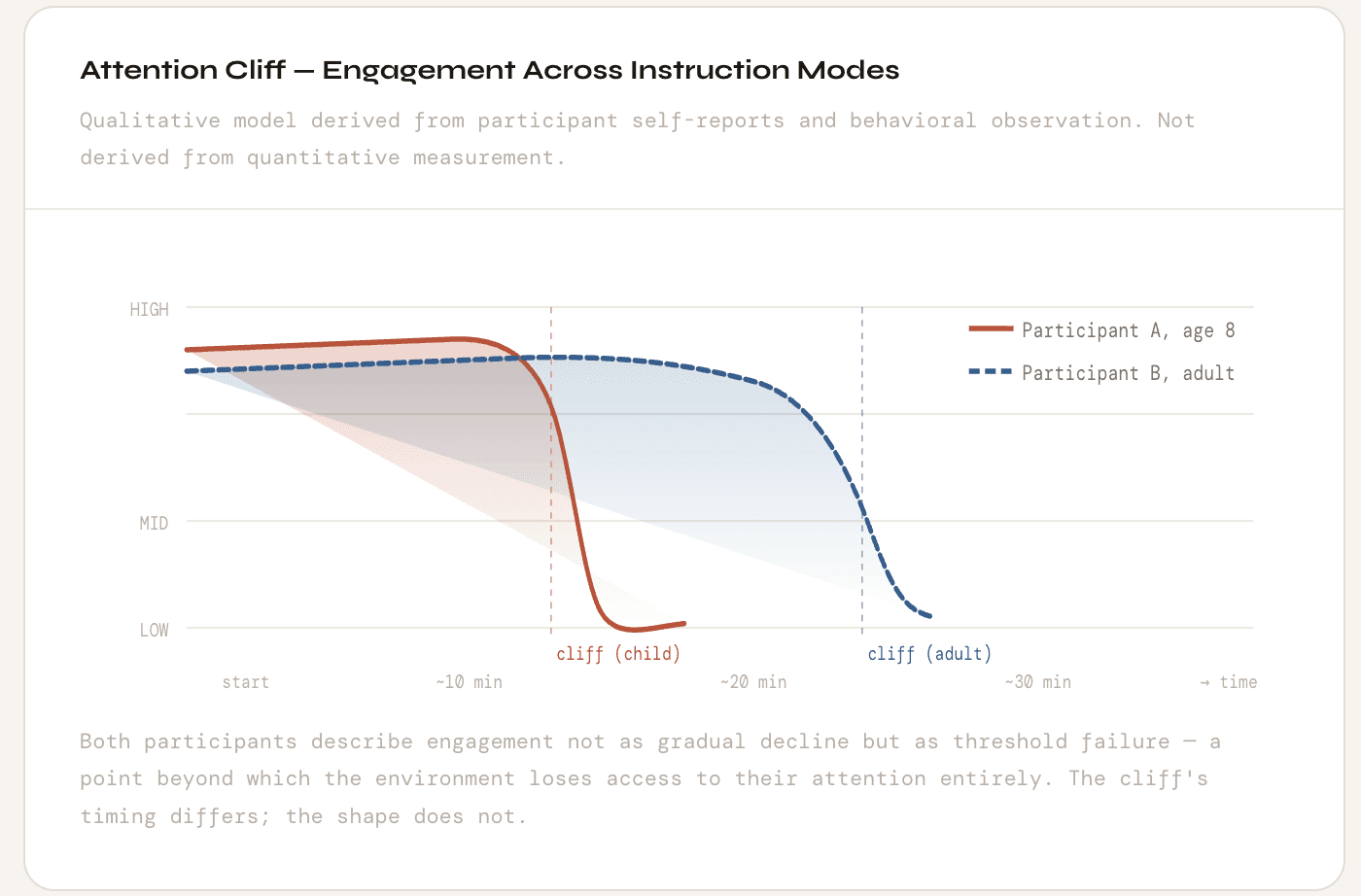
Neither participant described attention as something that faded gradually. Both described it as falling off a ledge.
Participant A's words were direct: "I get a little bit attention but when it comes to too much learning I don't get any attention." He described the physical response, head in hands, slumping, sudden inability to retain anything, not as a gradual drift, but as a shutdown. A threshold crossed, and everything after it lost.
Participant B reached for metaphor. He described learning to code through the lens of Harry Potter: the set pieces (battles, revelations, high-stakes moments) were why he showed up. The dialogue and exposition were tolerable but not sustaining. He knew he needed them. He just couldn't hold attention through them before the next active moment arrived.
The window lengths differ, an eight-year-old's is shorter than an adult's, but the mechanism is structurally identical: there is a threshold, and once it's crossed, the environment has lost the learner. Not permanently. Not because of deficit. The attention is still there. The format just stopped accessing it.
What the overlap reveals
When I laid the two interview transcripts side by side, five structural parallels emerged. Each one appeared independently in both cases without prompting.
Pattern | Participant A (age 8) | Participant B (adult) |
|---|---|---|
Processing mode | Needs to move, build, physically interact to encode material. Encodes multiplication through basketball shots and rock counting. action-first | Needs to write code and see output to understand concepts. "Writing code is the climax — the part I'm there for." action-first |
Attention pattern | Sharp threshold: "I get a little bit attention but when it comes to too much learning I don't get any attention." Described as physical shutdown, not drift. cliff model | Engagement follows a Harry Potter model: high during "set pieces," drops out during exposition. Knows he needs the dialogue. Can't sustain through it. cliff model |
Self-directed difficulty | Voluntarily builds math quizzes two grade levels above current. Rejects "kindergarten questions" as disrespectful. upward regulation | Skipped beginner tutorials; pushed into harder material early because early results justified the difficulty. Needs the challenge to stay. upward regulation |
Creation as encoding | Builds quizzes, wraps math problems in jokes, constructs games. Creating the material is the learning mechanism, not a byproduct of it. make to learn | First HTML page rendering was the breakthrough moment. "The act of making the thing was when it clicked." Seeing his output was the anchor. make to learn |
Stakes as sustainer | Recess creates natural stakes — miss the shot, try again, game continues. Engagement is sustained because the consequence is immediate and real. tangible stakes | Learned trucking successfully and quickly under financial pressure. Identified the stakes as the reason learning stuck where other methods failed. tangible stakes |
His ability never changes. His environment does.
Field note, Participant A observation session
The design flaw reframed
Traditional learning environments are built on one load-bearing assumption: that attention is a trait. Some learners have it. Some don't. The failure to sustain focus becomes a property of the person — a diagnosis, a character flaw, a deficit requiring accommodation.
The evidence from these two profiles — and from the broader research literature on embodied cognition, self-determination theory, and motivation — points to a different framing entirely. Attention isn't a trait. It's a response to conditions.
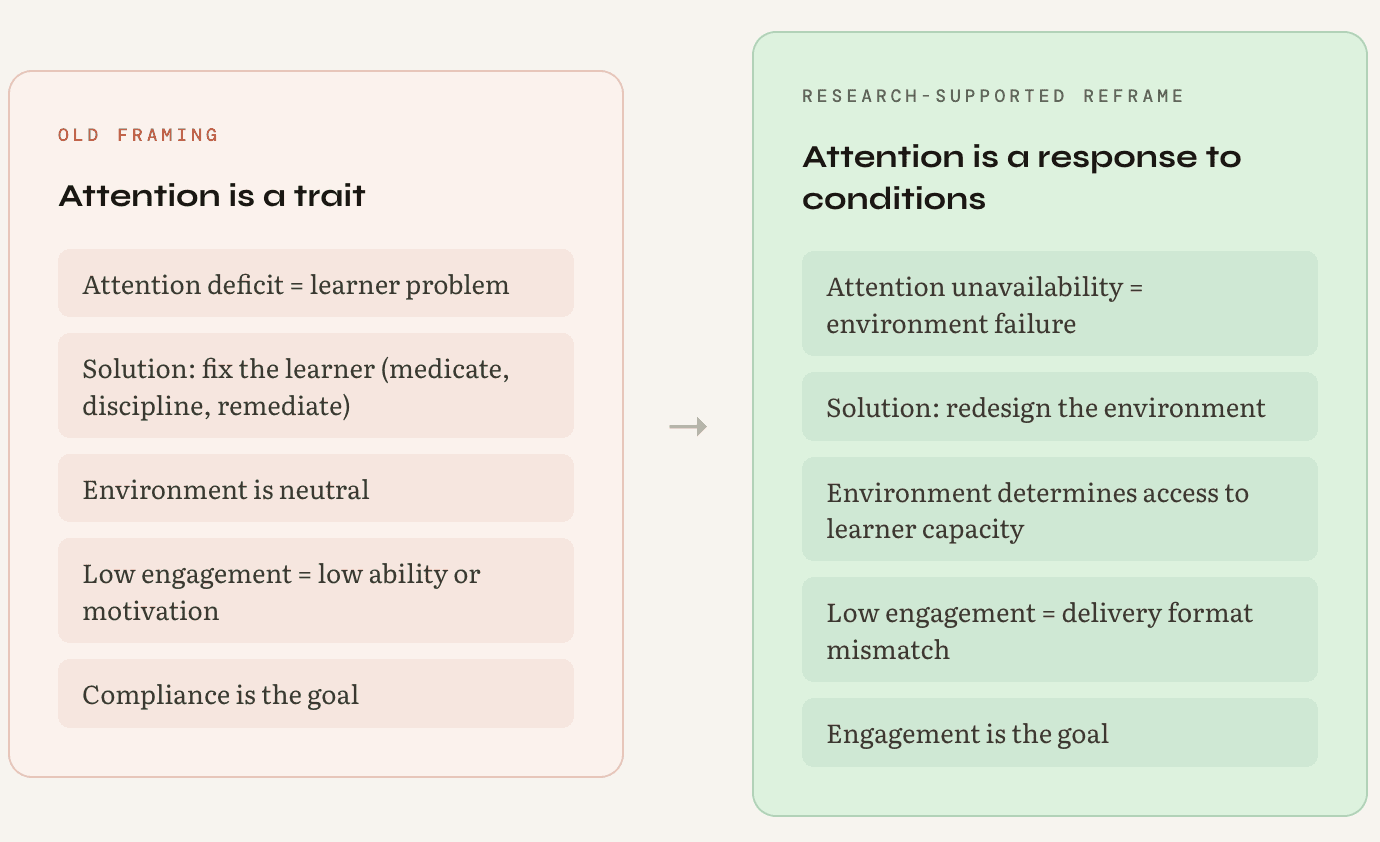
This reframe shifts the entire design challenge. If attention is a trait, the problem is the learner. If attention is a response, the problem is the room. Every piece of qualitative evidence I've collected so far points toward the second framing. The learner's ceiling isn't set by their ability. It's set by the environment they're asked to learn inside.
Five design principles derived from both profiles
These aren't prescriptions. They're hypotheses generated from pattern analysis and offered as design constraints. Each principle appeared independently in both profiles, which is what elevates them from anecdote to researchable claim.
Short active loops over long passive blocks
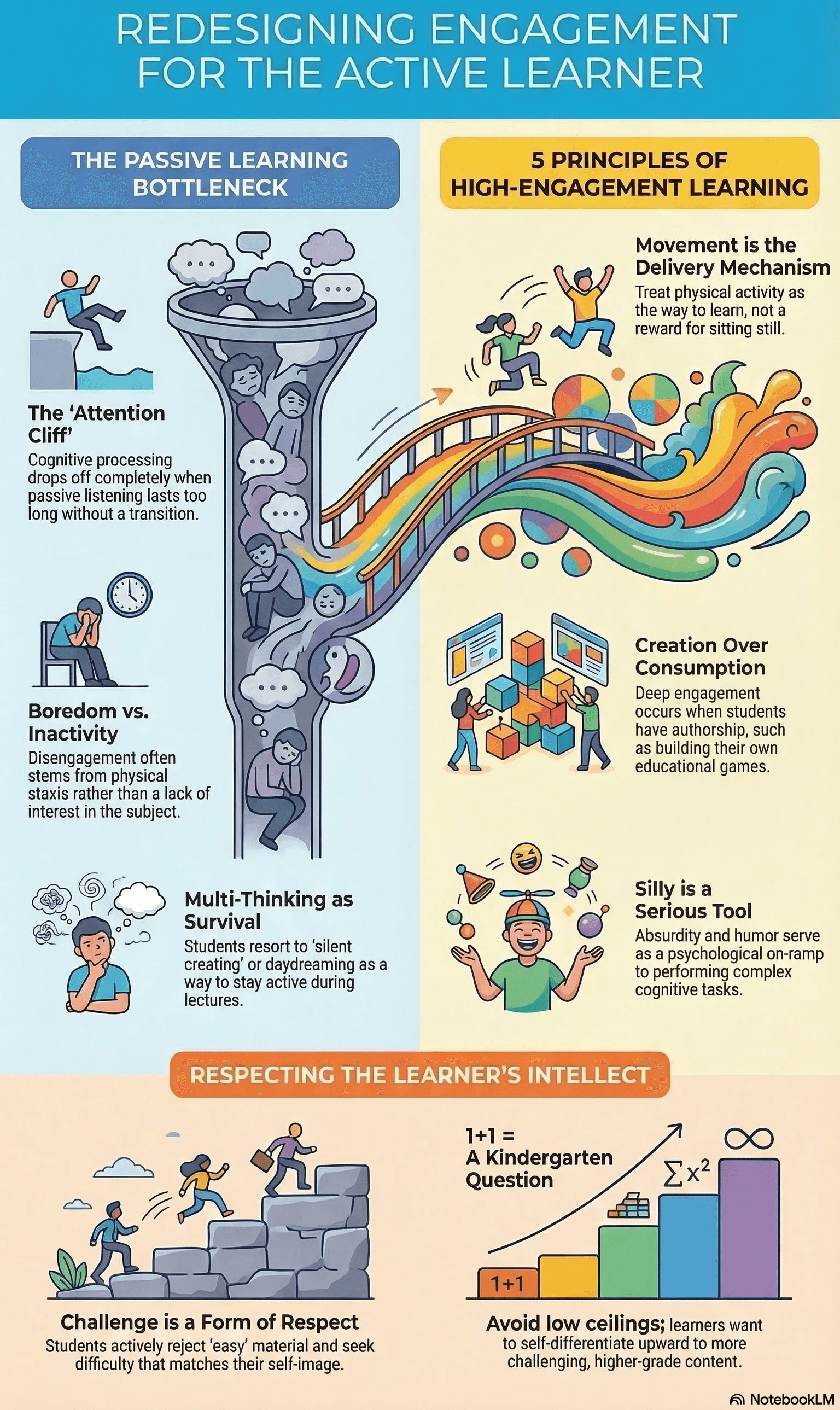
Both participants have a measurable attention cliff, not a gradual fade. Instruction that alternates between receiving, doing, and creating every 10–15 minutes operates under the threshold. Any single mode held past that window risks losing access to the learner entirely.
A: classroom shutdown after ~10 min passive instructionB: tutorial drift; sustained during active build phasesFirst wins early
Both participants needed fast, tangible proof that effort would produce something visible. Environments that front-load instruction and delay the payoff lose action-first learners before they've had a chance to demonstrate what they know. The first win functions as a commitment device, not a reward.
A: immediate engagement when physical challenge produces resultCreation as encoding, not decoration
Neither participant learns primarily by receiving information. Both learn by producing something and observing what happens. Making forces the brain to organize information into a structure. Passive consumption provides no such scaffold. Creation isn't a reward at the end of a lesson — it's the processing mechanism.
A: builds quizzes to understand concepts, wraps math in jokesB: writing code is the learning event; reading about code is notChallenge that signals respect
Both participants actively regulate difficulty upward when given freedom. Both interpret easy content not as accessible but as insulting. The message received from simplified instruction isn't "let's start here" — it's "we don't think you can handle more." Environments that default to easy lose these learners not because the work is too simple, but because simplicity communicates a ceiling they've already exceeded.
A: rejects grade-level questions; self-assigns 2 grades aboveB: pushed past beginner tutorials because early results justified harder materialPressure or stakes to sustain consistency
Neither participant sustains learning indefinitely through pure intrinsic motivation — both need environmental conditions that create urgency. For Participant A, recess creates natural stakes: miss the shot, the game continues without you. For Participant B, financial pressure made trucking acquisition fast and durable. Environments that create natural urgency — visible progress, team accountability, deadlines — sustain learners who can't sustain themselves through willpower alone.
A: full engagement during recess; natural consequences sustain focusB: trucking learned "quickly and consistently" under financial stakes
What this does and doesn't claim
Two participants don't prove a theory. They generate one. The structural overlap documented here is precise enough to warrant rigorous testing but not strong enough to generalize. What I'm building toward isn't a universal framework for learning — that ambition has produced too many contested typologies already. It's a design constraint set grounded in observed behavior.
The relevant research literature on self-determination theory (Deci & Ryan), embodied cognition (Wilson, 2002), and activity-based learning design provides a theoretical substrate for these patterns. But this archive is concerned primarily with what happens when you actually build environments based on these constraints — not just whether the literature supports them.
Participant A is eight years old and still inside a system that could catch him, if it tried. Participant B is in his mid-twenties and has spent years building workarounds because no environment ever adapted to him. The delta between those two outcomes is the design problem.
Where this research is going
The next phase is building and testing environments, not just analyzing them. Three active prototypes in development:
01 / outdoor | 02 / digital | 03 / hybrid |
|---|---|---|
Park Learning Prototype | Simulation-Based Adult Training | Math Game with Stakes |
Physical outdoor environment embedding academic concepts in spatial and kinesthetic challenges. Testing active-loop principle with children ages 6–10. | Consequence-first design environment for adult skill acquisition. Tests whether action-first architecture changes retention and engagement vs. instruction-first equivalents. | Digital math environment for children testing whether embedded stakes (timers, consequences, earned progress) extend engagement windows past the observed attention cliff. |
On methodology: Participant names have been anonymized or changed. Direct quotes are reproduced from interview notes and are presented as recalled, not transcribed verbatim. Behavioral observations were conducted in naturalistic settings without experimental controls. This research is exploratory and ongoing. Frameworks presented here are hypotheses, not conclusions.
Cited frameworks: Deci, E.L. & Ryan, R.M. (2000). Self-determination theory. Wilson, M. (2002). Six views of embodied cognition. Csikszentmihalyi, M. (1990). Flow: The psychology of optimal experience.
Name/Title | Method | Participants |
|---|---|---|
Miyya Cody Full Stack Product Designer | Semi-structured interviews Behavioral Observations | n=2; Ages 9 - 26 Independent Case Analysis |
Two participants. Twenty years apart in age. Completely different contexts. Describing the same structural failure and neither of them knowing the room was the problem.
METHODOLOGY NOTE
This article draws from semi-structured interviews with two participants recruited from my immediate research environment. Participant A is a child in third grade (age 8), observed across home and school contexts over multiple sessions. Participant B is an adult learner in his mid-twenties, interviewed about his experience with formal schooling and self-directed skill acquisition. Both interviews were conversational in format, averaging 25–40 minutes. Observations were coded thematically; this article presents a cross-case analysis surfacing structural parallels in how both participants experience and respond to learning environments. This is qualitative, exploratory research not a controlled study. Claims are bounded to pattern identification and hypothesis generation.
The Participants
When two people from completely different life stages describe the same cognitive experience in the same words, that convergence is worth examining. Not because two cases prove anything, they don't. But because the structural similarity is precise enough to be diagnostic.
Participant A | Participant B |
|---|---|
Child, Age 9 | Adult, Age 26 |
Third grader, recruited from home research environment | Self-directed learner, formal education in traditional system |
|
|
|
|
|
|
|
|
The Cliff
Neither participant described attention as something that faded gradually. Both described it as falling off a ledge.
Participant A's words were direct: "I get a little bit attention but when it comes to too much learning I don't get any attention." He described the physical response, head in hands, slumping, sudden inability to retain anything, not as a gradual drift, but as a shutdown. A threshold crossed, and everything after it lost.
Participant B reached for metaphor. He described learning to code through the lens of Harry Potter: the set pieces (battles, revelations, high-stakes moments) were why he showed up. The dialogue and exposition were tolerable but not sustaining. He knew he needed them. He just couldn't hold attention through them before the next active moment arrived.
The window lengths differ, an eight-year-old's is shorter than an adult's, but the mechanism is structurally identical: there is a threshold, and once it's crossed, the environment has lost the learner. Not permanently. Not because of deficit. The attention is still there. The format just stopped accessing it.
What the overlap reveals
When I laid the two interview transcripts side by side, five structural parallels emerged. Each one appeared independently in both cases without prompting.
Pattern | Participant A (age 8) | Participant B (adult) |
|---|---|---|
Processing mode | Needs to move, build, physically interact to encode material. Encodes multiplication through basketball shots and rock counting. action-first | Needs to write code and see output to understand concepts. "Writing code is the climax — the part I'm there for." action-first |
Attention pattern | Sharp threshold: "I get a little bit attention but when it comes to too much learning I don't get any attention." Described as physical shutdown, not drift. cliff model | Engagement follows a Harry Potter model: high during "set pieces," drops out during exposition. Knows he needs the dialogue. Can't sustain through it. cliff model |
Self-directed difficulty | Voluntarily builds math quizzes two grade levels above current. Rejects "kindergarten questions" as disrespectful. upward regulation | Skipped beginner tutorials; pushed into harder material early because early results justified the difficulty. Needs the challenge to stay. upward regulation |
Creation as encoding | Builds quizzes, wraps math problems in jokes, constructs games. Creating the material is the learning mechanism, not a byproduct of it. make to learn | First HTML page rendering was the breakthrough moment. "The act of making the thing was when it clicked." Seeing his output was the anchor. make to learn |
Stakes as sustainer | Recess creates natural stakes — miss the shot, try again, game continues. Engagement is sustained because the consequence is immediate and real. tangible stakes | Learned trucking successfully and quickly under financial pressure. Identified the stakes as the reason learning stuck where other methods failed. tangible stakes |
His ability never changes. His environment does.
Field note, Participant A observation session
The design flaw reframed
Traditional learning environments are built on one load-bearing assumption: that attention is a trait. Some learners have it. Some don't. The failure to sustain focus becomes a property of the person — a diagnosis, a character flaw, a deficit requiring accommodation.
The evidence from these two profiles — and from the broader research literature on embodied cognition, self-determination theory, and motivation — points to a different framing entirely. Attention isn't a trait. It's a response to conditions.
This reframe shifts the entire design challenge. If attention is a trait, the problem is the learner. If attention is a response, the problem is the room. Every piece of qualitative evidence I've collected so far points toward the second framing. The learner's ceiling isn't set by their ability. It's set by the environment they're asked to learn inside.
Five design principles derived from both profiles
These aren't prescriptions. They're hypotheses generated from pattern analysis and offered as design constraints. Each principle appeared independently in both profiles, which is what elevates them from anecdote to researchable claim.
Short active loops over long passive blocks
Both participants have a measurable attention cliff, not a gradual fade. Instruction that alternates between receiving, doing, and creating every 10–15 minutes operates under the threshold. Any single mode held past that window risks losing access to the learner entirely.
A: classroom shutdown after ~10 min passive instructionB: tutorial drift; sustained during active build phasesFirst wins early
Both participants needed fast, tangible proof that effort would produce something visible. Environments that front-load instruction and delay the payoff lose action-first learners before they've had a chance to demonstrate what they know. The first win functions as a commitment device, not a reward.
A: immediate engagement when physical challenge produces resultCreation as encoding, not decoration
Neither participant learns primarily by receiving information. Both learn by producing something and observing what happens. Making forces the brain to organize information into a structure. Passive consumption provides no such scaffold. Creation isn't a reward at the end of a lesson — it's the processing mechanism.
A: builds quizzes to understand concepts, wraps math in jokesB: writing code is the learning event; reading about code is notChallenge that signals respect
Both participants actively regulate difficulty upward when given freedom. Both interpret easy content not as accessible but as insulting. The message received from simplified instruction isn't "let's start here" — it's "we don't think you can handle more." Environments that default to easy lose these learners not because the work is too simple, but because simplicity communicates a ceiling they've already exceeded.
A: rejects grade-level questions; self-assigns 2 grades aboveB: pushed past beginner tutorials because early results justified harder materialPressure or stakes to sustain consistency
Neither participant sustains learning indefinitely through pure intrinsic motivation — both need environmental conditions that create urgency. For Participant A, recess creates natural stakes: miss the shot, the game continues without you. For Participant B, financial pressure made trucking acquisition fast and durable. Environments that create natural urgency — visible progress, team accountability, deadlines — sustain learners who can't sustain themselves through willpower alone.
A: full engagement during recess; natural consequences sustain focusB: trucking learned "quickly and consistently" under financial stakes
What this does and doesn't claim
Two participants don't prove a theory. They generate one. The structural overlap documented here is precise enough to warrant rigorous testing but not strong enough to generalize. What I'm building toward isn't a universal framework for learning — that ambition has produced too many contested typologies already. It's a design constraint set grounded in observed behavior.
The relevant research literature on self-determination theory (Deci & Ryan), embodied cognition (Wilson, 2002), and activity-based learning design provides a theoretical substrate for these patterns. But this archive is concerned primarily with what happens when you actually build environments based on these constraints — not just whether the literature supports them.
Participant A is eight years old and still inside a system that could catch him, if it tried. Participant B is in his mid-twenties and has spent years building workarounds because no environment ever adapted to him. The delta between those two outcomes is the design problem.
Where this research is going
The next phase is building and testing environments, not just analyzing them. Three active prototypes in development:
01 / outdoor | 02 / digital | 03 / hybrid |
|---|---|---|
Park Learning Prototype | Simulation-Based Adult Training | Math Game with Stakes |
Physical outdoor environment embedding academic concepts in spatial and kinesthetic challenges. Testing active-loop principle with children ages 6–10. | Consequence-first design environment for adult skill acquisition. Tests whether action-first architecture changes retention and engagement vs. instruction-first equivalents. | Digital math environment for children testing whether embedded stakes (timers, consequences, earned progress) extend engagement windows past the observed attention cliff. |
On methodology: Participant names have been anonymized or changed. Direct quotes are reproduced from interview notes and are presented as recalled, not transcribed verbatim. Behavioral observations were conducted in naturalistic settings without experimental controls. This research is exploratory and ongoing. Frameworks presented here are hypotheses, not conclusions.
Cited frameworks: Deci, E.L. & Ryan, R.M. (2000). Self-determination theory. Wilson, M. (2002). Six views of embodied cognition. Csikszentmihalyi, M. (1990). Flow: The psychology of optimal experience.